How to Track Leads and Brand Deals That Start in Instagram DMs
When a client gets enquiries and partnership offers through DMs, most of them are never written down anywhere. Here is a simple pipeline for agencies: what counts as a lead, the five fields every deal needs, how to credit the post that started it, and how to follow up inside Meta’s messaging rules.
By Kaitlyn Bricker · Updated October 14, 2026 · Pipeline, Instagram, Agencies, Reporting

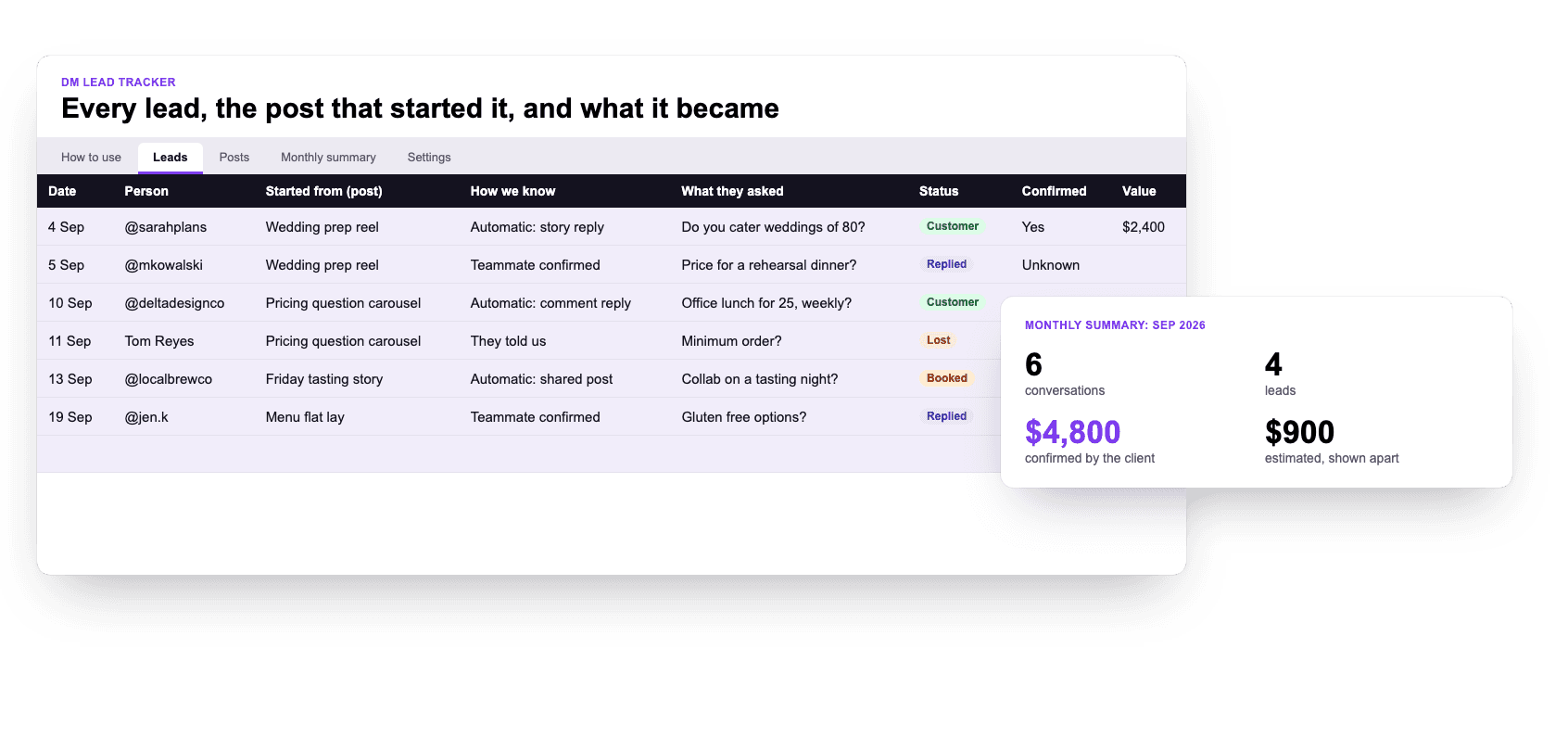
To track leads and deals that start in DMs, move every conversation that could turn into money out of the inbox and onto a simple pipeline with five stages, one owner and a value, and record which post the person saw first. If it only lives in the DM thread, it doesn't exist when the client asks what social did for them this quarter.
This applies whether your client's DM leads are customers ("can I book a consult?") or partners ("we'd love to send you product for a reel"). The mechanics are the same, and so is the problem: the conversation happened, maybe the deal closed, and three months later nobody can show it.
Decide what counts as a lead before you start counting
If you don't define this with the client up front, you'll either count every "how much?" as a lead and inflate the number, or count nothing until money changes hands and undersell the work.
A workable definition for most service businesses: a lead is someone who asked about buying, booking or pricing, and gave enough detail that a reply could move them forward. "How much?" on its own is interest. "How much for a 30-person event on the 14th?" is a lead.
For creators and brands that get partnership offers, use: a deal is an offer that names a deliverable or a budget. "Love your stuff, let's collab!" is not a deal. "We'd pay $800 for one reel and three stories in November" is.
Write the definition into the client's onboarding doc. When the quarterly review comes and you say "we generated 23 leads," you want the client nodding, not asking what a lead is.
Five stages are enough
Pipelines get abandoned when they have too many stages to keep updated. The default in Inexra is five, and I've rarely seen an agency need more:
- Inquiry. They asked. Nothing's been agreed.
- Interested. You've replied, they've engaged with the details.
- Negotiating. Price, date or scope is being worked out.
- Closed won. They booked, paid or signed.
- Closed lost. They went quiet, said no, or went elsewhere.
"Closed lost" matters more than people think. A lead that went quiet after a price quote is information. Five of them in a month on the same service means the price, the offer or the way it's being explained in DMs needs another look.
The five fields every deal needs
Each card on the pipeline should carry exactly these. Anything more is optional, and optional fields don't get filled in.
- Who: the person or brand, with a link back to the conversation.
- What: the thing they want, in a few words. "Corporate lunch for 40." "Two reels, product seeding."
- Value: an estimate is fine. A real number beats a blank every time, even if it's rough.
- Owner: one name. If the client's team handles closing, the owner is whoever on your side is making sure that happens.
- Where it came from: the post, reel or story the person saw before they messaged.
That last field is the one nobody fills in, and the one that matters most later.
Credit the post that started the conversation
When a client asks what their social media earned, "we got 12 leads from DMs" is good. "The October reel about the tasting menu started five of them, and two booked" is the sentence that renews a retainer.
To say that, you need to know which post each conversation came from. Some of this Instagram tells you: when someone replies to a story or shares a post into a DM, the message carries a reference to it. When your team replies privately to a comment and the person carries on in DMs, the link is there too. Inexra records those automatically. For everything else, someone on the team has to look at the conversation and pick the post, which takes about ten seconds if it's done when the lead comes in and is impossible three months later.
The rule we use for crediting deals: the deal goes to the earliest post linked to that conversation before the deal was created. If someone replied to your Tuesday story, chatted for a week, then booked, the Tuesday story gets the credit. It's simple, it's defensible in front of a client, and it doesn't pretend to precision you don't have. There's more on the methods and their blind spots in how to tell which post a DM came from.
Follow up inside Meta's rules
Most lost DM leads aren't rejected. They drift. Someone asks a question on Friday, you reply Monday, they've moved on.
Two platform rules shape how you follow up. Meta lets a business reply normally for 24 hours after the person's last message. After that, a reply only goes through if it's a person responding to that specific conversation, which Meta allows for up to seven days using the human agent tag. Automated nudges to everyone who went quiet are exactly what that rule forbids. The 24-hour window guide covers the details.
In practice: reply to new leads the same working day, and if a conversation is waiting on your client (a quote, a date, a yes), chase the client rather than letting the customer's window close. A deal sitting in "Interested" for more than three days with no reply from your side is the one to look at first each morning.
Report it in the client's language
At the end of the month the pipeline gives you numbers most social reports don't have: leads in, leads won, the value of what was won, and which posts started them. Put those near the top of the report, above reach and followers. The client will read them first anyway.
If the client has a monthly target, put the result against it: "You asked for 30 enquiries a month and got 34." That's the format that makes a renewal conversation easy. We go further into this in how agencies prove Instagram brings in leads.
FAQ
How do agencies track leads that come from Instagram DMs?
Move every conversation that could become a sale onto a pipeline (a CRM, a spreadsheet, or a pipeline in your social tool) with a stage, an owner, an estimated value and the post the person saw first. Update the stage as the conversation moves, and mark lost deals as lost rather than deleting them.
What's the difference between a lead and an enquiry in DMs?
Agree it with the client, but a useful line is that a lead asked about buying, booking or pricing with enough detail to move forward. "How much?" alone is interest; "how much for 30 people on the 14th?" is a lead.
How do I know which post a DM lead came from?
Story replies and post shares carry a reference to the post. Conversations that start from a reply to a comment can be linked too. For everything else, have someone pick the post when the lead comes in, and credit the deal to the earliest post linked to the conversation.
Can I follow up on a DM lead after 24 hours?
Only with a personal reply to that conversation, which Meta allows for up to seven days through the human agent tag. Automated or bulk follow-ups after 24 hours break Meta's messaging rules.