How to Make Instagram Posts People Send in DMs (the Signal That Now Outranks Likes)
Sends per reach, meaning DM shares, is the strongest ranking signal Instagram tracks. How to brief, write and review client posts that people forward, and how to measure it without guessing.
By Kaitlyn Bricker · Updated October 16, 2026 · Instagram, Algorithm, Content Strategy, Agencies
If you're still building Instagram content around likes, you're optimizing for a metric the algorithm barely counts anymore. Instagram head Adam Mosseri has confirmed the three signals that actually decide reach: watch time, likes per reach, and sends per reach. Of those three, sends per reach, meaning how often people forward your post to someone in DM, is now the strongest positive signal Instagram tracks. It outranks saves. It outranks comments. It outranks likes by a wide margin.
That's a real shift in what "good content" means for anyone posting on behalf of a brand or a client, and most agencies haven't rebuilt their content process around it yet.
What "sends per reach" actually measures
Sends per reach is exactly what it sounds like: the percentage of people who see your post and then send it to someone else via DM, divided by your total reach. It's a distribution metric, not an engagement metric, and that distinction matters.
A like tells Instagram "I noticed this." A DM share tells Instagram "I want a specific person to see this." The second signal requires the viewer to make a judgment call about someone else's taste, attach your content to their own credibility, and take an extra step to send it. That's a much higher bar than a tap, and Instagram's ranking systems now weight it accordingly.
This isn't a minor tweak. Multiple ranking signals used to sit close together in importance. Now there's a clear hierarchy: sends first, saves and watch time next, comments and likes trailing behind as the cheapest, lowest-friction signals a viewer can give.
Why DM shares outrank saves, comments, and likes
Each engagement type carries a different level of social risk, and Instagram's algorithm has essentially become a risk detector.
A like costs nothing. It's private, reversible, and doesn't require the viewer to think about anyone but themselves. A save is a slightly stronger signal, it's a private note to your future self that says "I want this later," which is why educational and reference-style posts have always earned outsized saves.
A DM share is different in kind, not just degree. When you send a post to a specific person, you're making a bet on two things at once: that the content is genuinely good, and that this particular person will think so too. If you're wrong, that's a small but real social cost. People don't take that bet on mediocre content. So when Instagram sees a post getting sent at a high rate, it reads that as one of the clearest available proxies for "this is actually worth spreading," which is exactly the outcome the platform wants more of in every feed it ranks.
Comments still matter for watch time and dwell signals, but they're cheap to fake and cheap to bait for, which is part of why Instagram has also gotten more aggressive about penalizing obvious engagement bait and recycled or AI-generated content that isn't adding anything new.
The content that actually gets sent
Not every post has the same shot at DM shares, and it helps to think about what makes someone stop scrolling and choose a specific person to send something to. In practice, three categories consistently outperform:
Identity content. Posts that make someone think "this is so [name]" or "this is literally us." Inside jokes, relatable frustrations, and callouts of shared experience travel because sending them says something about the relationship, not just the content.
Useful, complete information. Templates, checklists, frameworks, and how-tos that solve a specific problem someone else has. If a teammate or client would genuinely benefit from seeing it, people send it instead of just saving it for themselves.
Opinion and debate. Takes that are specific enough to have a side. Content that's mild or hedged doesn't generate sends because there's nothing to react to. Content with a clear point of view gives people a reason to tag someone and say "thoughts?"
Generic brand content, most product announcements, and anything that reads like a press release almost never gets sent, because there's no personal reason for the viewer to attach their name to it.
Here's a quick before-and-after. A caption that reads "5 tips for growing your Instagram" is a like magnet at best, it's generic advice with no clear recipient in mind. Rewritten as "Send this to the client who keeps asking why their Reels aren't getting reach," it names an exact person the reader has in their life, and gives them a specific, low-effort reason to forward it right now instead of scrolling past. Same information, completely different distribution outcome.
How to design posts for sends, not just views
A few practical shifts make a measurable difference here.
Write captions and on-screen hooks that name a specific audience, not a general one. "For anyone managing more than one client account" gets sent more than "tips for social media managers" because it invites the viewer to think of an actual person who fits that description.
End with a direct, natural nudge. "Send this to whoever's still doing this manually" works because it's specific and low-friction. Avoid engagement-bait phrasing like "tag 3 friends" or "send this to everyone you know," Instagram's detection systems have gotten better at identifying and suppressing that pattern, and it reads as desperate to real viewers anyway.
Favor formats that carry information cleanly: carousels with one clear idea per slide, short how-to Reels, before-and-after comparisons. These formats are naturally "forwardable" because the value is legible in a few seconds, which is exactly how long someone spends deciding whether to send something.
Post less, but make each post earn its place. The data on posting cadence backs this up: quality consistently outperforms volume, and most brands do better with a steady rhythm, something like 3 to 4 Reels and 2 to 3 carousels a week, rather than posting daily with weaker content. One post that gets shared widely does more for reach than five that get a handful of likes.
What this means if you're running content for multiple clients
If you manage Instagram for more than one account, this shift changes how you should brief and review content before it goes out. The question to ask in every content review isn't "will this get engagement," it's "who would actually send this, and why."
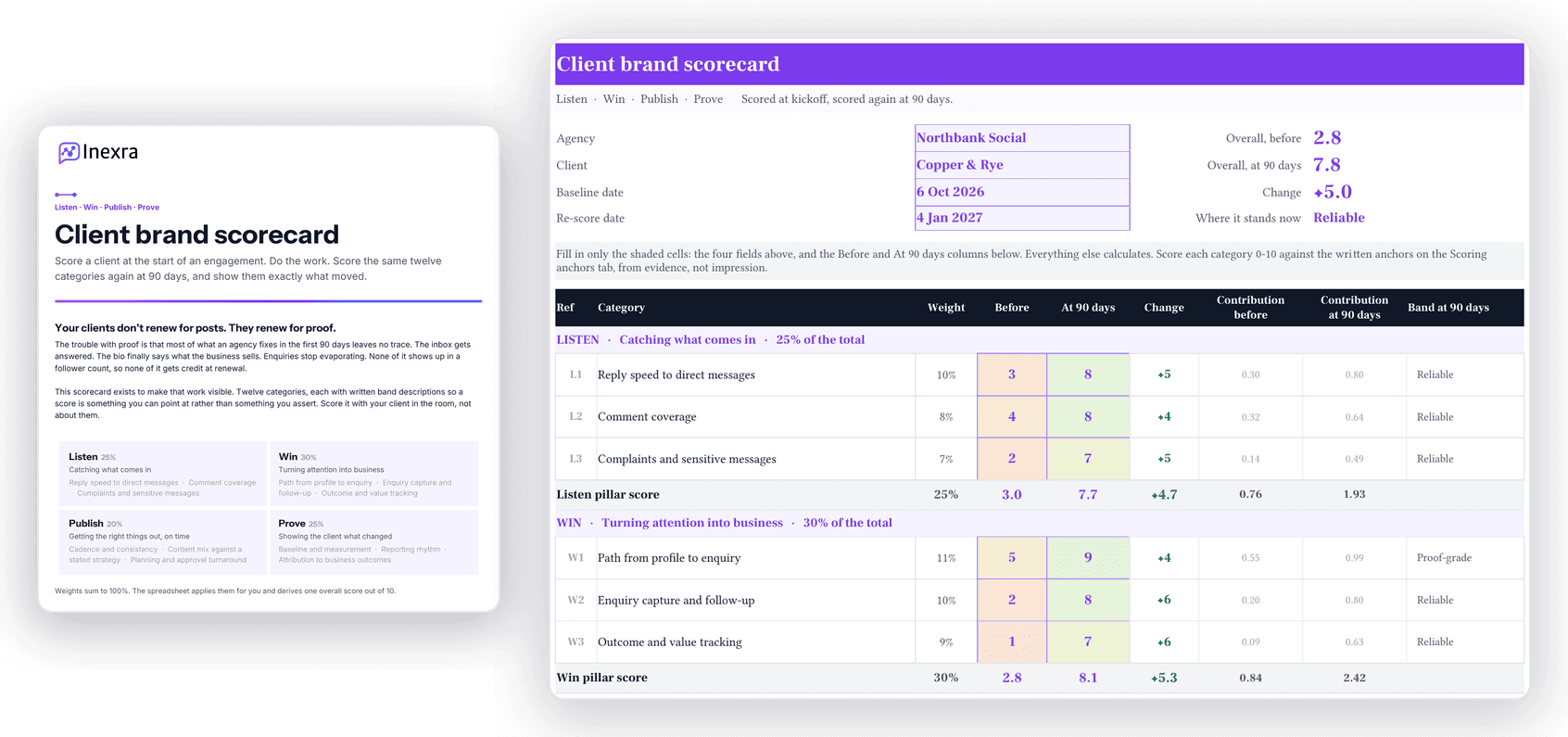
It also has a downstream effect worth planning for: content that earns more DM shares generates more inbound DMs, and some of those are leads. The post that got forwarded is often the post that started the conversation, so it pays to record which post each DM came from while the thread is fresh. That record is what lets you show a client that Instagram brought in leads instead of just reach. Inexra links each conversation to the post behind it, automatically where Meta tells us and with one click where it doesn't.
There's also a reporting angle worth building into your client updates now, before a client asks for it. If a post you made for a client starts moving because of DM shares rather than likes, that's a genuinely good story to tell: "this post is getting forwarded, not just liked," is a more credible signal of quality than a like count a client can't easily interpret. Agencies that start tracking and reporting sends per reach now will have a head start explaining it when clients start asking why their like counts look flat even as their business results improve.
Measuring sends per reach without guessing
Instagram doesn't expose "sends per reach" as a single labeled number in every account's analytics, but you can approximate it. In professional account insights, look at the "Shares" metric under each post's reach breakdown and divide by total reach for that post.
Say a Reel reaches 20,000 accounts and gets shared 340 times. That's a 1.7% sends-per-reach rate. On its own, that number doesn't mean much, there's no universal benchmark Instagram publishes. What matters is the trend across your own account: track it post over post, average it weekly, and watch the direction. If shares as a share of reach are climbing over time, your content is doing what the algorithm currently rewards. If likes are climbing while shares stay flat, you're winning a metric that carries less and less weight, and it's worth rewriting your next few captions with a specific person in mind rather than a general audience.
Don't try to game it
It's tempting to manufacture sends artificially, asking a team or a pod to forward posts to each other to juice the numbers early. Resist it. Instagram's ranking systems are explicitly built to detect unnatural engagement patterns, including coordinated sharing, and content that gets flagged this way tends to get suppressed rather than boosted. The same AI systems now used to catch recycled and low-effort content are trained on exactly this kind of pattern. The only durable way to win on sends per reach is to make something worth sending.
Build "would someone send this" into review
The simplest way to make this stick across several clients is to put the question into the review step every post already goes through. Add one line to your approval checklist: who is the specific person a viewer would send this to? If nobody on the team can name one, the post goes back for a rewrite before the client ever sees it. Mosseri has signaled ranking changes like this well before they fully take hold, and sends have stayed at the top across Feed, Reels and Explore, so the habit keeps paying off.
FAQ
What is sends per reach on Instagram?
Sends per reach is the number of times a post is sent to someone in a DM divided by the post's total reach. Adam Mosseri has named it as one of the three signals that decide reach, alongside watch time and likes per reach, and it is now the strongest positive signal Instagram tracks.
Do DM shares matter more than likes on Instagram?
Yes, by a wide margin. Instagram ranks a DM share above saves, comments and likes, because sending a post to a specific person puts the sender's own credibility behind it, which is a much higher bar than a tap.
How do I see how many times my Instagram post was shared in DMs?
Open the post's insights in a professional account and look at the Shares metric in the reach breakdown. Divide shares by the post's reach to approximate sends per reach, so 340 shares on a Reel that reached 20,000 accounts works out to 1.7 percent, and track that trend over time since Instagram publishes no benchmark.
What kind of Instagram posts get shared in DMs the most?
Three kinds of posts get sent most: identity content that makes someone think "this is literally us," useful and complete information such as templates and checklists, and opinions specific enough to have a side. Generic brand content and most product announcements almost never get sent.
Does asking people to tag friends hurt Instagram reach?
It can. Instagram has gotten better at detecting and suppressing engagement bait like "tag 3 friends," so a specific, natural nudge such as "send this to whoever's still doing this manually" works better. Coordinated sharing through pods or teams also tends to get a post suppressed.