Why Social Media Agency Clients Leave (and the Reporting Problem Behind Most of It)
Agencies tend to blame budgets and leadership changes when a client leaves. Clients mostly say the work did not deliver. For organic social the gap has a specific cause: the results arrive as conversations the owner handles personally, and the credit never reaches the agency. What the data says, the warning signs, and what to change.
By Kaitlyn Bricker · October 14, 2026 · Client Retention, Reporting, Agencies, Proof

Social media agency clients mostly leave because they can't see what the work did for them, even when it did something. Agencies tend to put losses down to budget cuts or a new decision-maker, but when clients are asked, the top reason is delivery. For organic social there's a specific reason those two views drift apart: the results show up as DMs, calls and walk-ins that the business owner handles personally, so the owner credits word of mouth or themselves, and the agency gets none of it.
The fix isn't more reporting. It's reporting the right thing: named customers traced back to the work.
What clients say versus what agencies think
Setup's Marketing Relationship Survey asked both sides why agency relationships end. 48% of clients said delivery issues were the main reason they fired an agency. Only 18% of agencies saw delivery as a top challenge.
That gap is the useful part. If you think clients leave for reasons you can't influence, you don't change anything. If most of them are leaving because they don't believe the work delivered, there's a lot you can change.
Agency owners seem to know reporting is part of it. In AgencyAnalytics' 2025 benchmarks survey, 70% of agency leaders said client reporting plays a critical role in retention. But more reporting doesn't fix it on its own. In Databox's survey of agencies, about a third said they believe fewer than 10% of their clients are comfortable with data. A forty-chart dashboard isn't proof to someone who can't read it.
A note on churn numbers: you'll see figures like "social media agencies lose 46% of clients a year" repeated across agency blogs. The most-cited source for that doesn't publish its sample or method, so I'd treat it as a guess. What the better surveys agree on is the direction, not a precise rate.
The specific problem with organic social
For paid ads, results are at least visible in the ad platform. For SEO, there's search traffic. Organic social for a service business is different, because the result usually isn't a click. It's a conversation.
Someone sees a reel, messages to ask about a booking, and the owner (or their front desk) handles it from there. A week later the owner is asked where new customers are coming from, and the honest answer in their head is "people message us" or "word of mouth." The post that started it is long forgotten. The agency did the work that generated the customer, and the credit evaporated at the moment it was earned.
Multiply that by a few months and you get the classic churn conversation: "We're not really seeing results from social." The results were there. They just weren't written down anywhere the client would see them.
The test: can the client repeat the value to someone else?
Here's a useful way to judge your reporting. After reading it, could the client explain to their business partner, their accountant or their spouse what the agency did for them this month, in one or two sentences?
"Reach was up 18% and engagement held steady" fails the test. Nobody repeats that.
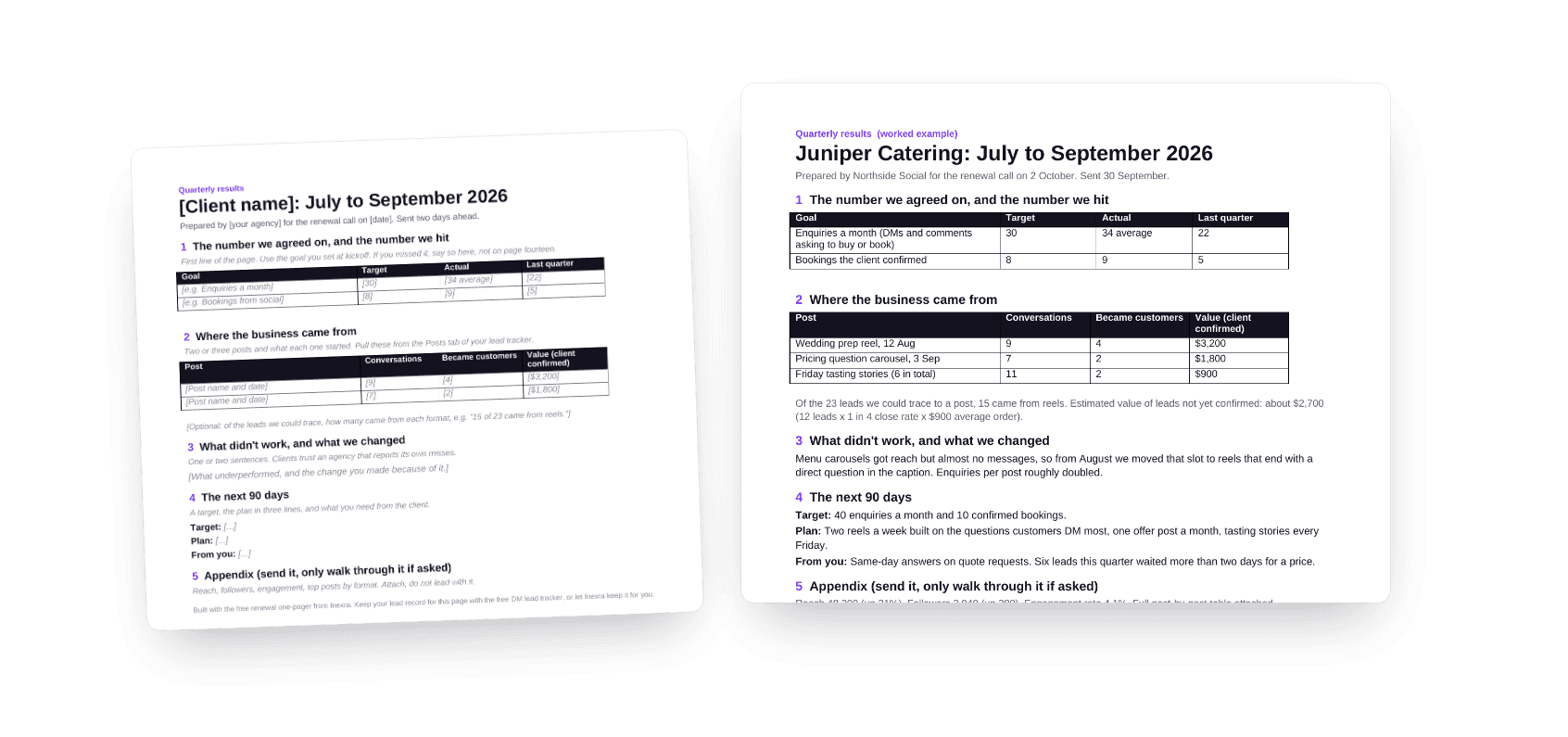
"Twenty-three people messaged asking to book this month, and six of them became customers. Most came from the tasting menu reel." That passes. It's specific, it's about their business, and it's a sentence someone will actually say out loud.
Gartner found only 52% of senior marketing leaders say they can prove marketing's value and get credit for it. Your client is in the same position with whoever they answer to. Give them the sentence.
Warning signs, in the order they usually show up
- Slower replies on approvals and content requests. The client is giving the account less attention, often because it's become a cost they don't think about rather than a result they look forward to.
- Reports opened late or not at all. If you share reports by link, you can often see this.
- "What are we actually getting from this?" Usually phrased casually. It's not casual.
- Questions about price or scope that weren't there before. Often the first sign they're comparing you to an alternative.
- A new person joins calls. Sometimes a partner or finance lead brought in to review spending.
The first two are when to act. By the third, the client has usually half decided.
What to change
Agree a goal at kickoff that's close to money. Booking enquiries, quote requests, customers. Put it at the top of every report so the client sees progress against it every month.
Record where each lead came from, as it happens. Every conversation that asks about buying, linked to the post that started it. There's a method in how to tell which post a DM came from.
Ask the client which leads became customers. One question a month, five minutes of their time, and it turns your lead count into confirmed customers. It also makes the client an active participant in the proof rather than an audience for it. More in proving ROI when the client doesn't track revenue.
Lead every report with the sentence they can repeat. Leads, customers, and the post behind them. Everything else comes after.
Check in at month three, not just at renewal. The first three months are when a client decides whether you're worth keeping. A short call at month three, built around the goal, catches doubts while they're still questions.
Where Inexra fits
We built Inexra around this problem. It links each client's DMs and comment conversations to the posts that started them (automatically where Instagram sends the source, confirmed by a teammate where it doesn't), tracks the leads and deals that come out of them, and puts the result in a client report against a monthly goal. The report reads "23 people asked to book, and the tasting menu reel started 7 of those conversations," not a wall of charts. You can do all of this with a spreadsheet and discipline, too; the important part is doing it.
FAQ
Why do social media agency clients leave?
Most often because they don't believe the work delivered. In Setup's survey, 48% of clients named delivery issues as the main reason they fired an agency, while only 18% of agencies saw delivery as a top challenge. For organic social, the results often arrive as DMs and calls the owner handles personally, so the agency doesn't get the credit unless it records them.
What's the average client churn rate for a social media agency?
There's no reliable figure. Numbers like 46% a year circulate widely, but the main source doesn't publish its sample or method. Better surveys agree that delivery and visible results are the biggest factors, rather than giving a precise rate.
How do I know a client is about to cancel?
Early signs are slower replies on approvals, reports opened late or not at all, and casual questions like "what are we getting from this?" Questions about price or scope, or a new person joining calls, usually come later. Act at the first two.
Does better reporting actually reduce churn?
Reporting that shows outcomes the client cares about helps; longer reports don't. The test is whether the client could explain the value to someone else in a sentence, such as "23 people asked to book and 6 became customers."