How to Prove Social Media Results to Clients: The Agency Guide
The whole method in one place. Agree what counts at kickoff, record every lead where it starts, tie it to the post behind it, put a value on it, and bring one page to the renewal call. Each step links to the detailed guide.
By Kaitlyn Bricker · October 15, 2026 · Proof, Reporting, Renewals, Agencies

To prove social media results to a client, count the people social brought in and show where each one came from. Agree at kickoff on what counts as a result, record every lead where it starts (usually a DM or a comment), note the post that started it, and once a month ask the client which of those people became customers. Bring that list to every report and to the renewal call. A named list of people the client recognises is harder to argue with than any reach chart.
This page is the map. Each step below has its own detailed guide, linked at the end of the step, and the two free templates at the bottom of the page (a DM lead tracker and a renewal one-pager) cover steps 2 to 6.
Why reach and engagement don't hold up at renewal
Reach, impressions and likes are what the platforms report, so they're what most client decks lead with. The trouble is that a client can't connect any of them to money. When the budget gets reviewed, the question is "what did we get for this?", and a follower count doesn't answer it.
That gap is behind most lost accounts. The client rarely leaves because the work was bad. They leave because nobody could show them it worked, and a cheaper agency or an in-house hire looks just as good on paper. We go through the pattern in why social media agency clients leave.
Step 1: Agree what counts before the work starts
Proof is easier when the client agreed to the measure in advance. At kickoff, write down two or three outcomes they care about in their own words: booked appointments, quote requests, wholesale inquiries, people who mention Instagram at the till. Then write down where things stand today.
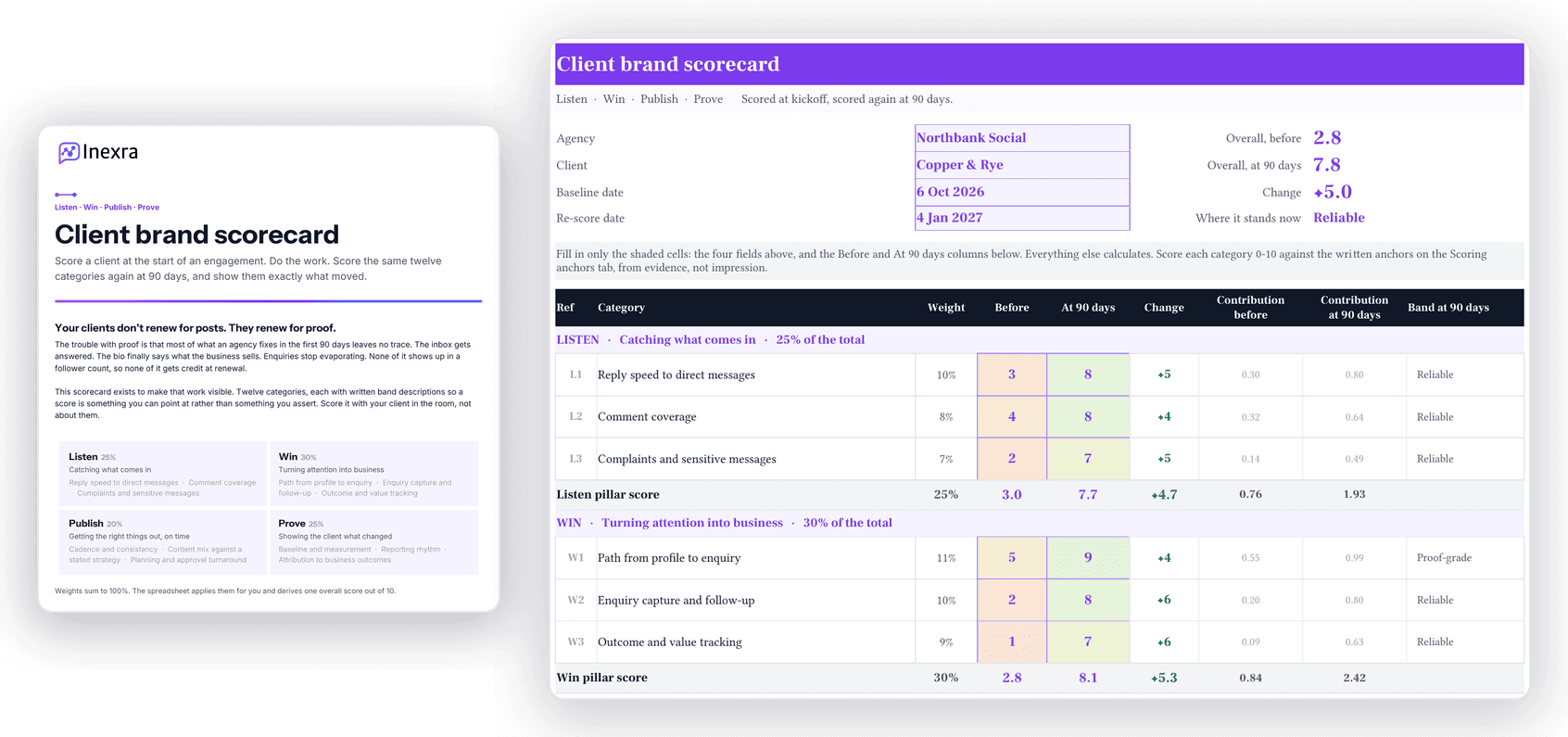
That baseline is what makes the 90-day comparison possible. Our free client scorecard scores an account across twelve categories at kickoff and again at 90 days, so the before and after sit on the same page.
Step 2: Record every lead where it starts
For a service business, most social leads never touch the website. Someone sees a reel, sends a DM asking about availability, and books by phone. Google Analytics sees none of that.
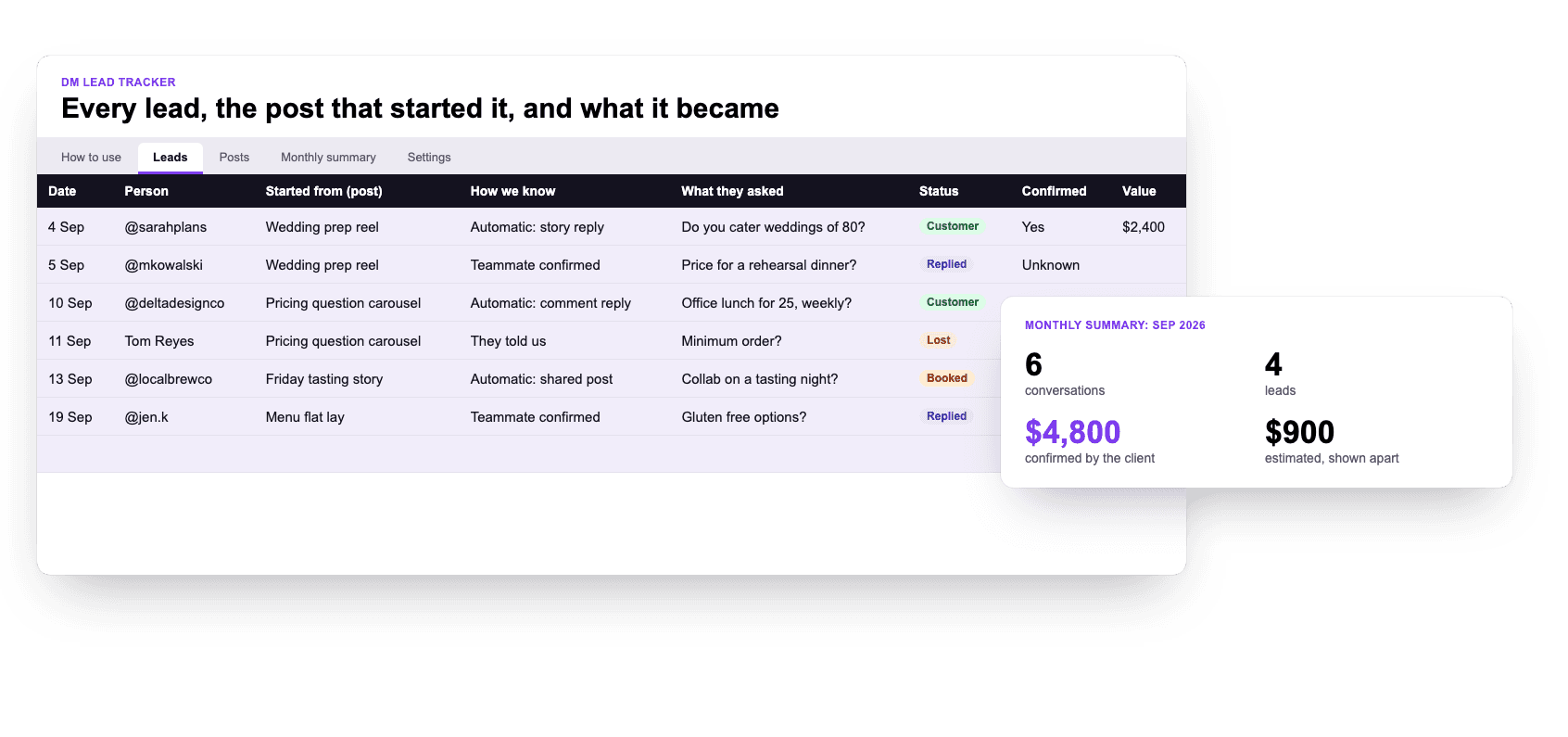
So keep the record where the lead happens. Every conversation that asks about buying, booking or pricing goes on a running list with the date, the person, and what they wanted. Three months of that list is the core of your proof. The full method, including the monthly question that closes the loop, is in how agencies prove Instagram brings in leads.
Step 3: Tie each lead to the post behind it
A list of leads proves social works. A list of leads with the post that started each one proves your work works, and tells you what to make more of.
Instagram passes the source along for some messages: story replies, posts someone shares into the DM, and answers to a comment you replied to privately. For the rest, someone on the team has to confirm it, or you plan for it up front with a keyword or a tracked link per post. How to tell which Instagram post a DM came from ranks every method by how far you can trust it.
The same idea applies to brand partnerships that start in DMs. Tracking leads and brand deals that start in Instagram DMs covers what to log so a collab can be credited later.
Step 4: Put a value on it, even without revenue data
Most small clients don't track revenue by source, and many never will. You don't need them to. Ask the client for three numbers once: roughly what a new customer is worth, how many inquiries it takes to win one, and which of this month's leads turned into customers.
From there you can show confirmed value (customers the client named) separately from estimated value (leads multiplied by their own conversion rate). Keeping the two apart is what makes the client trust both. How to prove social media ROI when the client doesn't track revenue walks through a full worked example.
Step 5: Report the same numbers every month
The monthly report should lead with leads and outcomes against the goal from Step 1, then show which posts started the most conversations. Response time belongs in there too, because a lead that waits a day often goes cold. Leave out numbers the client can't act on.
What to put in the inbox section of a client report lists the four inbox numbers worth reporting and the ones to drop.
Step 6: Bring one page to the renewal call
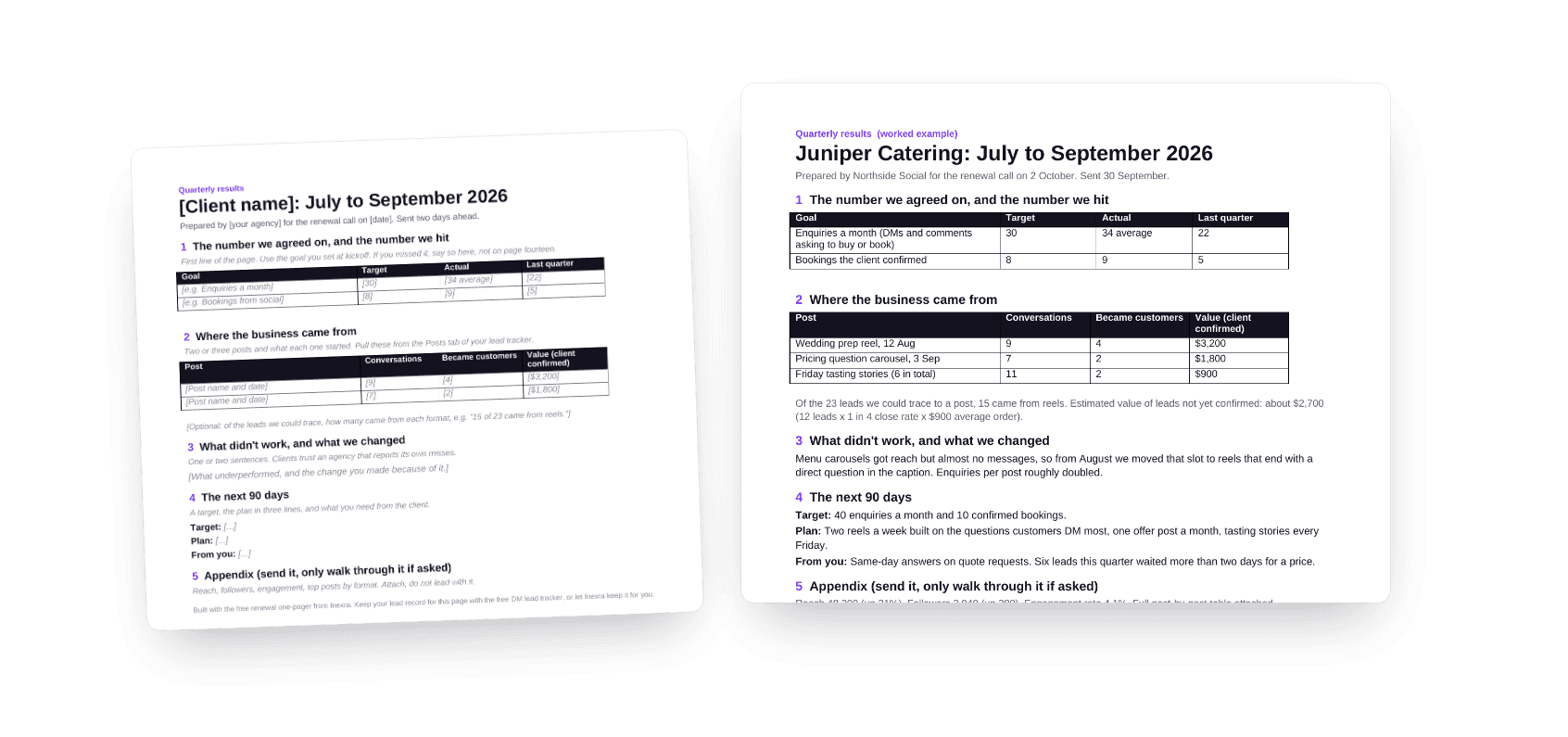
Everything above adds up to one page: the number you agreed on and the number you hit, where the business came from, what didn't work and what you changed, and the plan for the next 90 days. Send it a few days before the call so the client has read it before anyone talks price.
What to show a client at the renewal call has the page in the order the client reads it, plus what to say when the quarter was weak.
Starting mid-contract
If you're months into an account with none of this in place, start with Step 2 today and Step 1 at your next check-in. Even four weeks of a lead list is enough to open the next report with real people instead of reach. Ask the client to look back over the last month and name anyone who came in through social; that gives you a starting point while the new records build up.
Doing this in Inexra
Inexra keeps the lead list for you. Every client's DMs and comments land in one inbox per client, each conversation is linked to the post that started it (automatically where Instagram sends the source, confirmed by a teammate where it doesn't), and leads and deals are credited back through the conversation. The client report shows the result against the monthly goal you set. If you'd rather start by hand, a shared spreadsheet with the columns from Step 2 does the same job.
FAQ
How do I prove social media results to a client?
Count the people social brought in and show where each came from. Record every conversation that asks about buying or booking, note the post that started it, ask the client monthly which became customers, and report that list against a goal you agreed at kickoff.
What should I show clients instead of likes and reach?
Leads and customers, the posts that started them, and how fast the team replied. Reach and engagement can sit in an appendix, but they shouldn't lead the report.
How do I show ROI if the client doesn't track sales?
Ask the client what a new customer is worth and how many inquiries it takes to win one, then show confirmed value (customers they named) separately from estimated value (leads times their own conversion rate).
When should I start tracking results for a new client?
At kickoff, before the first post goes out, so you have a baseline to compare against at 90 days. If you're already mid-contract, start recording leads today.